
DREAM INTERPRETATION
UNDERSTANDING GOD’S MESSAGE IN DREAMS
Dreams can carry instruction from God, but we must learn how to interpret them with Scripture and careful judgement.
Dreams are one way God communicates with us. He may use a dream to make us aware of something, encourage us, warn us, prepare us, protect us, or lead us to change our current path.
I do not treat vivid dreams casually. Some dreams simply come from the events of the day — what I call “pizza-like dreams.” They are scattered and usually carry no message. But when a dream is vivid, clear, and stays with me, I pray and ask God what He is showing me.
“In a dream, in a vision of the night, when deep sleep falls upon men, while slumbering on their beds, then He opens the ears of men and seals their instruction, that He may turn man from his deed and conceal pride from man.”
Job 33:15–17
During the end times, more people will receive vivid dreams from God. Acts 2:16–17 says, “Your young men shall see visions, and your old men shall dream dreams.” Therefore, it is important to know how to understand dreams carefully.
SHARING YOUR DREAM
Some principles to remember when sharing a dream:
- Do not share it to look spiritual.
- Do not share it to prove a point.
- Do not share it to cause division.
- Remember, the dream was given to you.
- Share only with those who can benefit or help interpret it wisely.
- Do not give what is holy to those who will not value it.


HOW TO INTERPRET
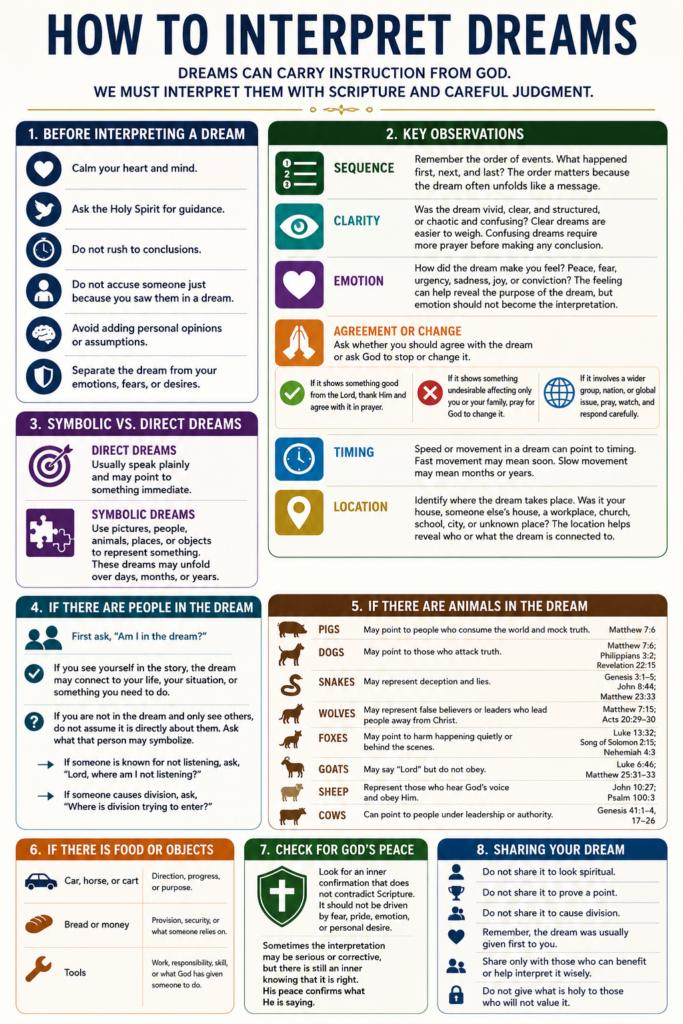
- Before Interpreting a Dream
* Calm your heart and mind.
* Ask the Holy Spirit for guidance.
* Avoid adding personal opinions or preconceived ideas about the people involved.
* Keep the dream’s meaning separate from your emotions or assumptions. - Key Observations
Remember the order of events. What happened first, next, and last? The order matters because the dream often unfolds like a message.
Sequence: Remember the order of events. What happened first, next, and last? The order matters because the dream often unfolds like a message.
Clarity: Was the dream vivid, clear, and structured, or chaotic and confusing? Clear dreams are easier to weigh. Confusing dreams require more prayer before making any conclusion.
Emotion: How did the dream make you feel? Did you feel peace, fear, urgency, sadness, joy, or conviction? The feeling can help reveal the purpose of the dream, but emotion should not become the interpretation.
Agreement or Change: Ask whether you should agree with the dream or ask God to stop or change it.
If the dream shows something good from the Lord, thank Him and agree with it in prayer.
If it shows something undesirable affecting only you or your family, pray for God to change it.
If it involves a wider group, nation, or global issue, pray, watch, and respond carefully.
Timing: Speed or movement in a dream can point to timing. Fast movement may mean soon. Slow movement may mean months or years.
Location: Identify where the dream takes place. Was it your house, someone else’s house, a workplace, church, school, city, or unknown place? The location helps reveal who or what the dream is connected to. - Symbolic vs. Direct Dreams
Direct dreams usually speak plainly and may point to something immediate.
Symbolic dreams use pictures, people, animals, places, or objects to represent something. These dreams may unfold over days, months, or years. - IF there are people: Determine is it for You or others
First ask, “Am I in the dream?” If you see yourself in the story, the dream may connect to your life, your situation, or something you need to do. If you are not in the dream and only see others, do not assume it is directly about them. Ask what that person may symbolize.
For example, if someone is known for not listening, ask, “Lord, where am I not listening?” If someone causes division, ask, “Where is division trying to enter or where am I causing it?” - IF there are animals: Determine you involvement
Animals generally refer to types of people to avoid or help. Here is a brief list:
• Pigs: They consume everything the world offers, and when they hear the truth, they mock it (trample it) and then chase it away. (Matt. 7:6).
• Dogs: Those who have no regard for truth, but are angry with (shout/bark at) and cause harm (bite) to those who share the truth. (Matt. 7:6; Phil. 3:2; Rev. 22:15).
• Snakes: These are individuals who speak lies convincingly and boldly. They are deceptive and misleading. (Gen. 3:1–5; John 8:44; Matt. 23:33).
• Wolves: These people appear to be believers and may even have credentials, share testimonies, and say “Amen,” but their actions and words are inconsistent with Christ’s teachings. They seek to lead genuine believers astray and cause harm. (Matt. 7:15; Acts 20:29–30).
• Foxes: These people may appear harmless, but their intent is often to cause harm, typically operating in the dark and in collaboration with others. (Luke 13:32; Song of Sol. 2:15; Neh. 4:3).
• Goats: They may stay among the sheep and seem peaceful, but they reveal their true nature when one turns away. They are self-centered and tend to disrupt and harm those sent to them. Their lack of good fruit and genuine obedience to Christ is a clear sign of their true nature. As Yeshua said, “Why do you call me ‘Lord, Lord,’ and do not do what I say?” (Luke 6:46; Matt. 25:31–33).
• Sheep: True believers are those who fear God, listen to His voice, and obey Him. (John 10:27; Ps. 100:3).
• Cows: People under the authority of a king. (Gen. 41:1–4, 17–26). - IF there is food or objects: Determine you involvement
Generally food refers to personal situation and what this symbolizes to you. For example: Car / Horse / Cart = Direction, purpose, or progress. Bread / Money = Sustenance, provision or something you or others rely on, feel secure in. Tools that you use in your trade, generally represent your work and what is going to happen with it.
- Check if you have inner peace with the interpretation
His voice gives us an answer of inner peace (2 Tim. 1:7)—a peace that isn’t based on logic, comfort, tradition, or emotion. It may deliver a tough message, yet you know it is right, or it may signal something is wrong. This inner knowing confirms what is true (Gen. 41:16; Ps. 85:8; Phil. 4:6–8; Col. 3:15; 1 John 2:27). His peace validates the words He speaks.
BIBLICAL EXAMPLES OF DREAMS
| Who Had the Dream | Why the Dream Was Given | Was It Something for Them to Do? | Who Did It Impact? |
|---|---|---|---|
| Abimelech (Gen. 20:3–7) | To prevent Abimelech from defiling Abraham’s wife | Return Abraham’s wife | Abraham, Abimelech, and Sarah |
| Jacob (Gen. 28:10–22) | To encourage Jacob | To be aware | Jacob |
| Joseph (Gen. 37:5–11) | To plant a seed for the future | To later encourage them that it was part of God’s plan | Jacob’s family |
| Butler (Gen. 40:9–13) | To elevate Joseph and encourage the butler | To be aware and later free Joseph by sharing with Pharaoh | Joseph, the baker, and the butler |
| Baker (Gen. 40:16–19) | To confirm Joseph’s prophetic gift and reveal the outcome | To be aware | Joseph, the baker, and the butler |
| Pharaoh (Gen. 41:1–32) | To save people from famine | Prepare for the famine, as he had the authority to act | All regions around Egypt |
| Dream About Gideon (Judg. 7:13–15) | To strike fear into Gideon’s enemies so they would flee | To encourage Gideon | The Israelites |
| Solomon (1 Kgs. 3:5–15) | Because Solomon sought the Lord’s help and offered sacrifices — God granted him wisdom | To be aware | Solomon |
| Nebuchadnezzar – Statue Dream (Dan. 2:1–45) | To reveal the future kingdoms that would rule Israel and the final Kingdom of God | To understand that God had allowed it | The Israelites and the world |
| Nebuchadnezzar – Pride Dream (Dan. 4:4–33) | To reveal Nebuchadnezzar’s pride | To humble himself, as Daniel advised — though he delayed a year before it happened | Nebuchadnezzar |
| Daniel (Dan. 7:1–28) | To reveal future kingdoms and prophetic events | To write it down and share with future generations | The Israelites and the world |
| Joseph – Dream 1 (Matt. 1:20–21) | To confirm his role as head of the family | Take Mary as his wife | Mary and Joseph |
| Joseph – Dream 2 (Matt. 2:13–14) | To guide and protect his family | Go to Egypt for safety | Joseph, Mary, and Yeshua |